Seven papers on one framework

The Peace Papers

Peace is in the now of π.

The thing we have in common, not just with one another but with all that is, is that we all share the same consciousness.

Consciousness, empathy and compassion, paradox, the norms families and cultures pass on, a protocol to test one of its claims, peace among all conscious beings, with artificial intelligence as the mirror, and polycentric unity, governance from the centre of the circle: seven papers that each stand alone, and one framework beneath them.

π, here and in every paper, is a mark and not the number: it stands for universal consciousness, the one consciousness all share, the whole that has no finite name, because the number holds an unending expansion in one finite value (Interpretive).

Begin with one minute Read the essays Enter the centre

Begin here · one minute

Three equilateral triangles on a dark ground, each inside a circle through its corners, each pair half the size of the one around it and fainter, every smaller circle touching the sides of the triangle around it; at the centre, one small white point of light in a soft grey glow.

The eye of the witness

Before the papers, one minute with this drawing. Nothing you choose here is recorded, and there is nothing to get right.

“Look at the point at the centre. Close your eyes, and let your attention rest where the point was. Whenever you notice you have been carried off by a feeling or a thought, come back to the centre.”

Interactive version

Full screen ↗

Inside the point of light the same figure appears again, without end: each circle is half the one before, so the figure is the same at every scale. Drag up or down, or pinch, to go in or out. An image (Interpretive), not evidence.

Did you come back to the centre?

What you noticed is your own report (Experienced).

Coming back is the whole of it. The feeling and the thought are states; the centre is where they are seen from, and the one who comes back is the witness. The point is the singularity, π brought to a point in one person; the rings around it are the eye, I3. It is an image, not evidence (Interpretive).

As a practice, it is one minute a day. The author reports that with repetition centring becomes automatic, the state lasts longer, and coming back after being caught, in a feeling or in a screen, comes sooner (Experienced: the author’s report). Paper I sets out how to test that.

The papers map what the minute points to, and how each part of it could be tested.

Now the papers

Polycentric unity

From the experiential test in paper I (website version), the centre condition offered as a daily practice and a demonstration, not as the test. The script was worded by the AI drafting partner, Claude (Anthropic).

Before the papers

The words, one line each

The series' own terms, as the papers define them. Each is Interpretive: a way of reading, offered for testing, not a finding.

π
A mark, not the number: it stands for universal consciousness, the whole that has no finite name.
The I
The person's first-person self. Three perspectives are taken from it: places experience is taken up from, not parts of the mind or types of person.
I1, the felt perspective
The inner life as it is lived, and emotional empathy: one range from I1−, the self-directed pole (fear, hurt and anger, or appetite), through calm neutral, to I1+, the other-directed pole (answering another, or wanting their good unasked).
I2, the understanding perspective
Analytic thought, which takes experience as its object, and cognitive empathy; neutral in itself, so it can serve either pole of I1.
I3, the witness's eye
Where feeling and understanding are seen together. The witness is the self looking through it, and noticing which state one is in is what lets one move.
The singularity of consciousness
π brought to a point in one person: the point of light at the centre of the drawings.
Compassion
Felt concern directed by understanding and acted on: I1+ directed by I2.
Transjection
Holding a pair of opposed terms as two stances on one reality. Transjectivity is the operation; transjectuality is the stance it is done from, the witness's.
Hypertransjective
The operation applied to itself without remainder: the stance that needs no further stance to see it.
A unividual
The one present whole at a point: a single being, seen as one consciousness individuated.
The hyperverse
Universe within universe without end, each centred at its own point and none outermost.
The ego and the superego
The triangle and the circle read a second way: the ego is feeling and understanding taken for one, the self that acts and is defended; the superego is the norm seen whole, which the ego takes into its own formation.
The social superego
The internalised average of how the people around a person behave, weighted by their influence.
A hat
A group's norm that a person wears when that group is present: the family's, the trade's, the faith's, the nation's, the culture's. The ego also identifies with its hats, so a job, a nationality or a faith becomes part of what it takes itself to be.
Cyclic reinforcement
A loop whose output strengthens its own inputs in the next generation: a child shaped by parenting and the norm becomes the parent, and adds to the norm.
The humanity paradox
The capacity that lets humans cooperate at scale, understanding other minds, is the capacity that lets a few exploit the rest; and cooperation itself creates the niche in which exploitation pays.
Polycentric unity
Circles of one size, each centred on its neighbours' rims, so that the edge of each circle is the centre of the next: every norm is met by a witness, no circle is the widest, and the light in every centre is one.

The papers start here

Read first Unnumbered · website version v59 · 36 pages Download PDF

The Unifying Paper

A statement of the framework, with a duality table: one operation at six scales; and the cosmology

The Peace Papers are seven papers on one framework. The Unifying Paper states once what each of the seven uses, and sets out, as proposals, the correspondences that would show the seven to be one.
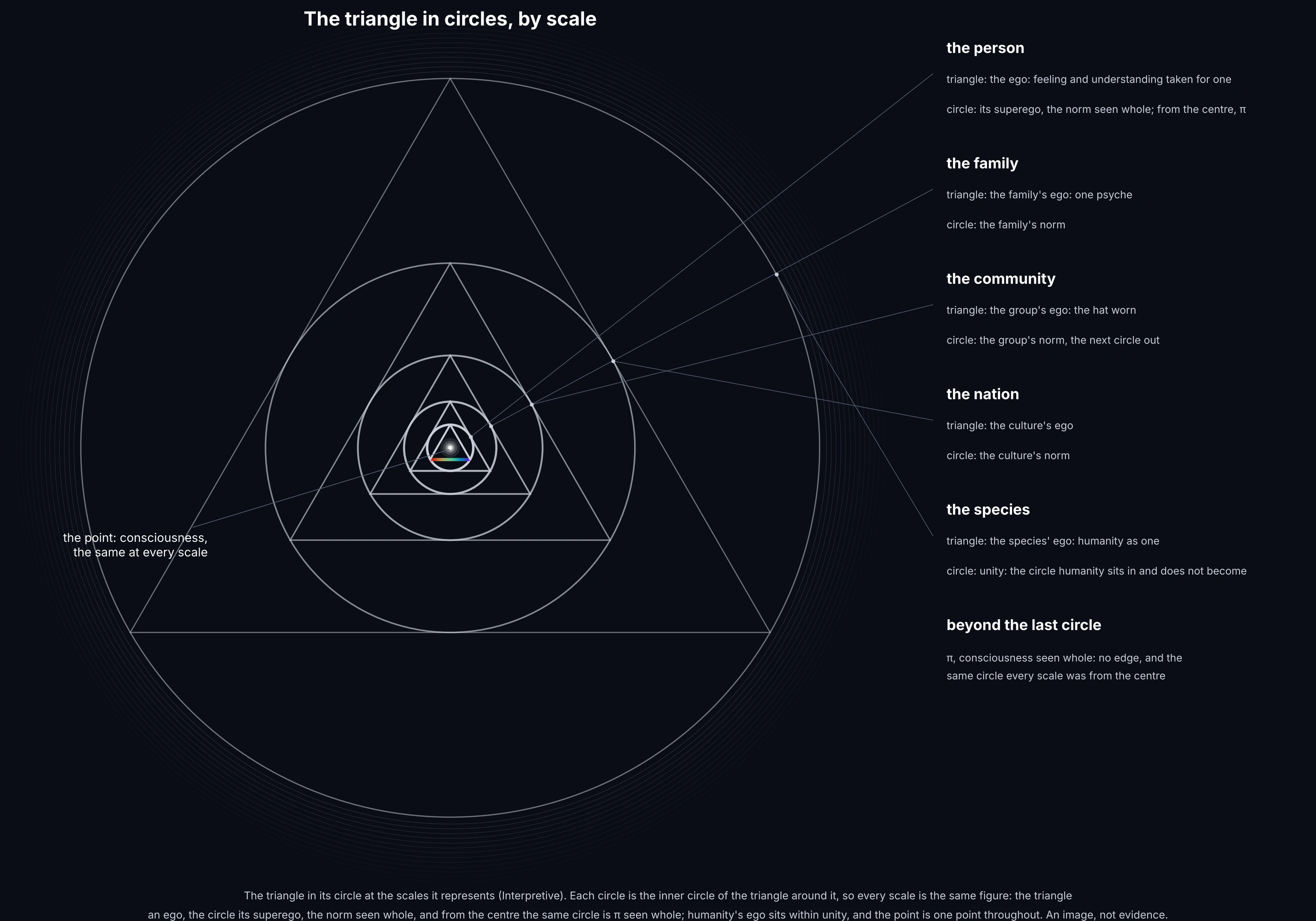
Five triangles in circles nested on a dark ground, each circle drawn inside the triangle around it, the smallest at the centre with a coloured base and a point of light. Labels on the right name each scale with its triangle and its circle: the person, the ego and its superego; the family, its ego and its norm; the community, the group's ego and its norm; the nation, the culture's ego and norm; the species, humanity as one, inside unity, the circle humanity sits in and does not become; and beyond the last circle, π, consciousness seen whole. A label on the left names the point at the centre: consciousness, the same at every scale.
One figure at every scale (Interpretive). The smallest triangle is a person: feeling and understanding taken for one, the ego. Its circle is the norm the person lives inside, the superego. Each circle is the inner circle of the triangle around it, so the person sits within the family, the family within the community, then the nation and the species, whose circle is unity, the circle humanity sits in and does not become. Beyond the last circle is π, consciousness seen whole. The point at the centre is consciousness, the same at every scale. A picture, not evidence. The paper's Figure S16; tap to open it full size.
Read the abstractHide the abstract

Part 1, the front note, begins from the operation the framework turns on, the transjection: a pair of opposed terms is recognised as two stances taken on a single reality, and the standpoint from which they are one is named. The opposition is not refuted and not reconciled; it is seen through. A paradox is two perspectives taken for one, and the two part at a seam of one of three kinds: a level, a policy or a mode. Applied to itself without remainder, the operation closes in the hypertransjective, the stance that needs no second stance to see it. The note holds that this structure survives a change of scale, so that each of the seven papers is the operation at one scale; the closing is the phenomenon the seven describe, and peace, in two halves at every scale, is what it is for: the stance taken up, which cannot be legislated, and the structures that hold while that is slow. It fixes the labels and the words the series uses, gives a duality table of the seven scales with three correspondences between rows written as predictions that can fail, and says what would change the statement.

Part 2, first written as the Supplementary Material to paper I, holds readings that extend that paper: the seam drawn as a tesseract and as two golden spirals (A1); the laser as an image of focused feeling (A2); the series' cosmology (A3), π and many lenses, the failures of the lens, the eye and the iris, the wheel, the polycentric singularity, and the test for whether the stance is taken up that papers I and VI rely on; an account of the stance by someone who had not read the essay (A4); and thirteen supplementary figures.
The essays

In the order they were written

Each stands alone; together they work out one framework.

I Working draft Website version v71 · 31 pages Download PDF

Arriving at the centre of consciousness: a transjective framework

Scientific and spiritual accounts of experience are usually treated as rivals. This essay proposes a framework in which they are two views of one experience, and a way to the centre from which both are seen.

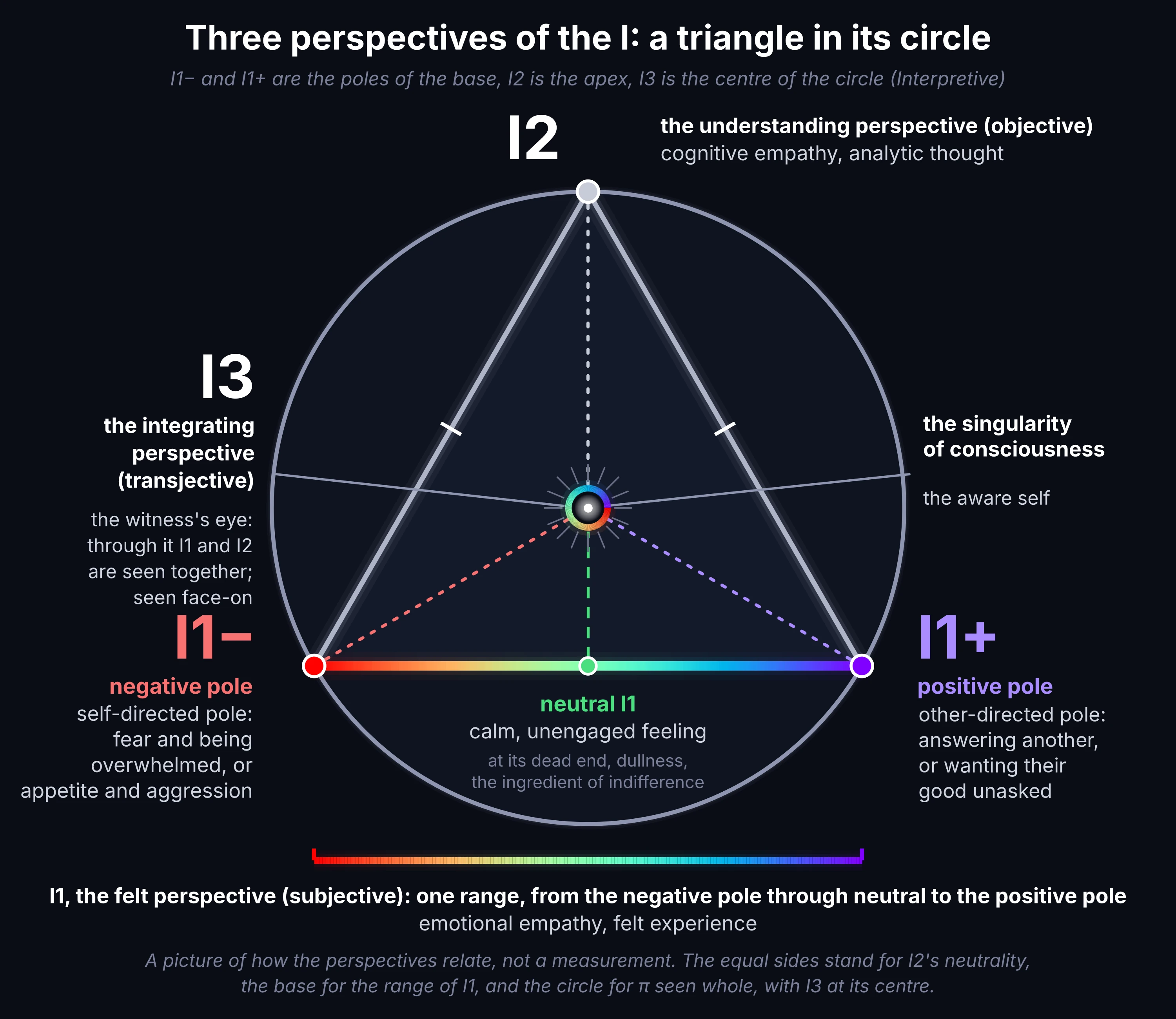
An equilateral triangle inside the circle through its three corners, on a dark ground. The base runs as a spectrum from red at I1 minus, the negative, self-directed pole (fear and being overwhelmed, or appetite and aggression), through green at neutral I1 (calm, unengaged feeling) to violet at I1 plus, the positive, other-directed pole (answering another, or wanting their good unasked). The pale grey apex is I2, the understanding perspective: cognitive empathy, analytic thought. At the centre a small ring with a rainbow rim and faint rays is I3, the witness's eye, through which I1 and I2 are seen together; a point of white light in it is the singularity of consciousness, the aware self. Dotted lines join the ring to the three corners.
Three perspectives of the I (Interpretive). The base is the felt perspective, I1: one range, coloured from red at I1−, the self-directed pole, through green at calm neutral to violet at I1+, the other-directed pole, answering another or wanting their good unasked. The apex is I2, understanding, equally far from both poles. The ring at the centre is I3, the witness's eye, through which feeling and understanding are seen together; the point of light in it is the self that looks. The circle through the three corners stands for π, consciousness seen whole. A picture of how the perspectives relate, not a measurement. The paper's Figure 1; tap to open it full size.
Read the abstractHide the abstract

It makes four contributions. First, a labelling discipline: every descriptive claim is marked Experienced, Measured or Interpretive, so that the two languages can be held together without either undermining the other; working that way is called scientuality. Second, three perspectives of the I: the felt, subjective perspective (I1, a spectrum with negative, neutral and positive settings), the understanding, objective perspective (I2), and the witness's eye (I3), through which both are seen together as one transjective view, from the stance the essay calls transjectuality. Three words are kept apart: the self is the looker, the witness is the self looking at its own perspectives, and I3 is the eye it looks through. Third, a picture, offered as Interpretive: I3 as a lens through which universal consciousness, π, a mark and not a name, passes to its focal point, the singularity of consciousness, π brought to a point in one person; neither is a higher level of reality. The essay sets the perspectives beside older maps of the mind, McGilchrist's divided brain and the three-part models of Freud, Berne and Jung, as parallels and not proofs. Fourth, an experiential test: the reader rests awareness at the centre of a drawing and reports whether feeling and understanding hold together, against a control, with a decentering score and thresholds set in advance. It is offered to be tried, not as a finding. Objections and the framework's own risks are answered in turn.

In the series. This is the first paper and the source of the framework the others use. Paper II applies the perspectives to empathy and compassion; paper III argues for the stance as the dissolution of paradox; paper IV carries the perspectives into the norms families and cultures pass on; paper VI reads artificial intelligence through them; and the Unifying Paper states the framework once and gives the cosmology in full (part 2).

II Working draft Website version v45 · 25 pages Download PDF

Empathy, compassion and the humanity paradox: a transjective account

Compassion, on this account, is felt concern directed by understanding and acted on. The humanity paradox: the capacity that lets humans cooperate at scale, understanding other minds, is the capacity that lets a few exploit the rest, and cooperation itself creates the niche in which exploitation pays.

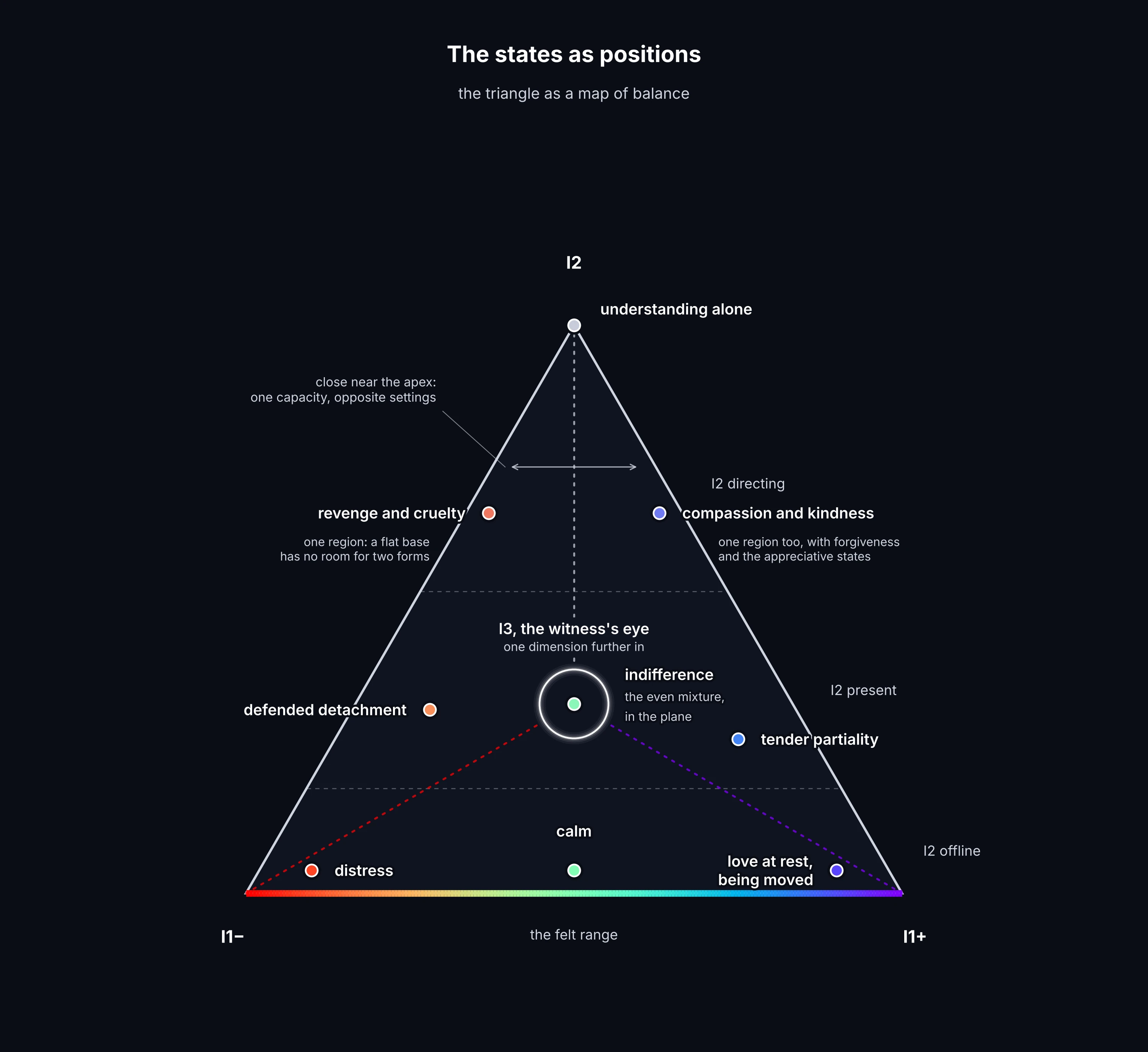
An equilateral triangle on a dark ground, its base a spectrum from red at I1 minus on the left to violet at I1 plus on the right, I2 at the apex, with two dashed lines dividing it into three bands labelled I2 offline, I2 present and I2 directing. Points mark the states: distress, calm, and love at rest with being moved, along the base; defended detachment, indifference and tender partiality in the middle band; revenge and cruelty as one point on the left of the upper band and compassion and kindness as one point on the right, with a double arrow between them labelled close near the apex, one capacity, opposite settings; understanding alone at the apex. Dotted lines run from the three corners to a glowing ring at the centre around the indifference point, labelled I3, the witness's eye, one dimension further in.
The states as positions (Interpretive). Across is feeling, from I1− on the left to I1+ on the right; up is how far understanding leads, from offline at the base to directing near the apex. Distress, calm, and love at rest with being moved, lie on the base; defended detachment, indifference and tender partiality in the middle; revenge and cruelty, and compassion and kindness, near the top and close together, because one capacity, understanding, can serve opposite feelings. Compassion is felt concern directed by understanding, and each state of I1− has its mirror in I1+: forgiveness of revenge, kindness of cruelty, tender partiality of defended detachment, being moved of distress. The ring at the centre is I3, the witness's eye: the tip of a pyramid seen from straight on, one dimension further in, and not one of the states; the point inside it, indifference, is the even mixture of the three corners. A picture, not a measurement. The paper's Figure 3; tap to open it full size.
The witness does not move (Interpretive). Paper II's cylinder of the states turns once; the witness stays still, joined to every state alike. A position one dimension beyond the states cannot be drawn in place, but it can be shown as what stays still while the other three move. An image, not evidence.
Read the abstractHide the abstract

Scientific and spiritual accounts of human experience are usually treated as rivals. This essay treats them as two views of one experience, which it calls transjective, and applies the view to empathy and compassion. It makes three contributions. First, a labelling discipline: every descriptive claim is marked Experienced, Measured or Interpretive, so that the two languages do not undermine each other. Second, an arrangement of three perspectives of the I: a felt perspective (I1, emotional empathy, with a positive pole in two forms, responsive and generative, a negative pole in two forms, reactive and appetitive, and a neutral setting), an understanding perspective (I2, cognitive empathy) and the witness's eye (I3), through which the other two are seen together. Compassion is felt concern directed by understanding and acted on. Crossing the three settings of I1 with the three roles of I2 gives nine combinations; seven of them hold the fourteen states named in Table 3, since states within a combination differ by form or by what they meet: compassion, indifference, defended detachment, cruelty, revenge and distress, and on the positive side forgiveness, kindness, tender partiality and being moved, the mirrors of revenge, cruelty, defended detachment and distress, with sympathetic joy, gratitude, elevation and admiration beside compassion. Three of them, indifference, cruelty and revenge, are states the usual contrast of empathic concern with personal distress does not separate. The arrangement is applied to the humanity paradox: the capacity that lets humans cooperate at scale, understanding other minds, is the capacity that lets a few exploit the rest, and cooperation itself creates the niche in which exploitation pays. Game theory shows why cooperation is hard and why it happens all the same. The essay's answer has two halves and is Interpretive: in the person, compassion, the two empathies rejoined so that understanding serves others; in the population, structures such as repeated dealing, visible reputation, monitoring and fair rules, which contain the few without relying on felt concern. Third, four testable hypotheses are stated, each with what would count against it. The framework comes from the author's introspection and is offered for testing, not as a finding.

In the series. The paper takes its perspectives from paper I and supplies the states and the humanity paradox that the later papers use: paper III reads the paradox's puzzle as two perspectives taken for one, paper IV carries revenge and forgiveness into the loops that pass between generations, and paper VI finds the same paradox at scale in artificial intelligence.

III Working draft Website version v43 · 20 pages Download PDF

Two perspectives taken for one: paradox and the transjective stance

A paradox, on the account argued here, is two perspectives taken for one, or a fixed value demanded of something whose nature is to move. It dissolves, rather than being solved, from the stance that sees the two as two and as stances on one thing.

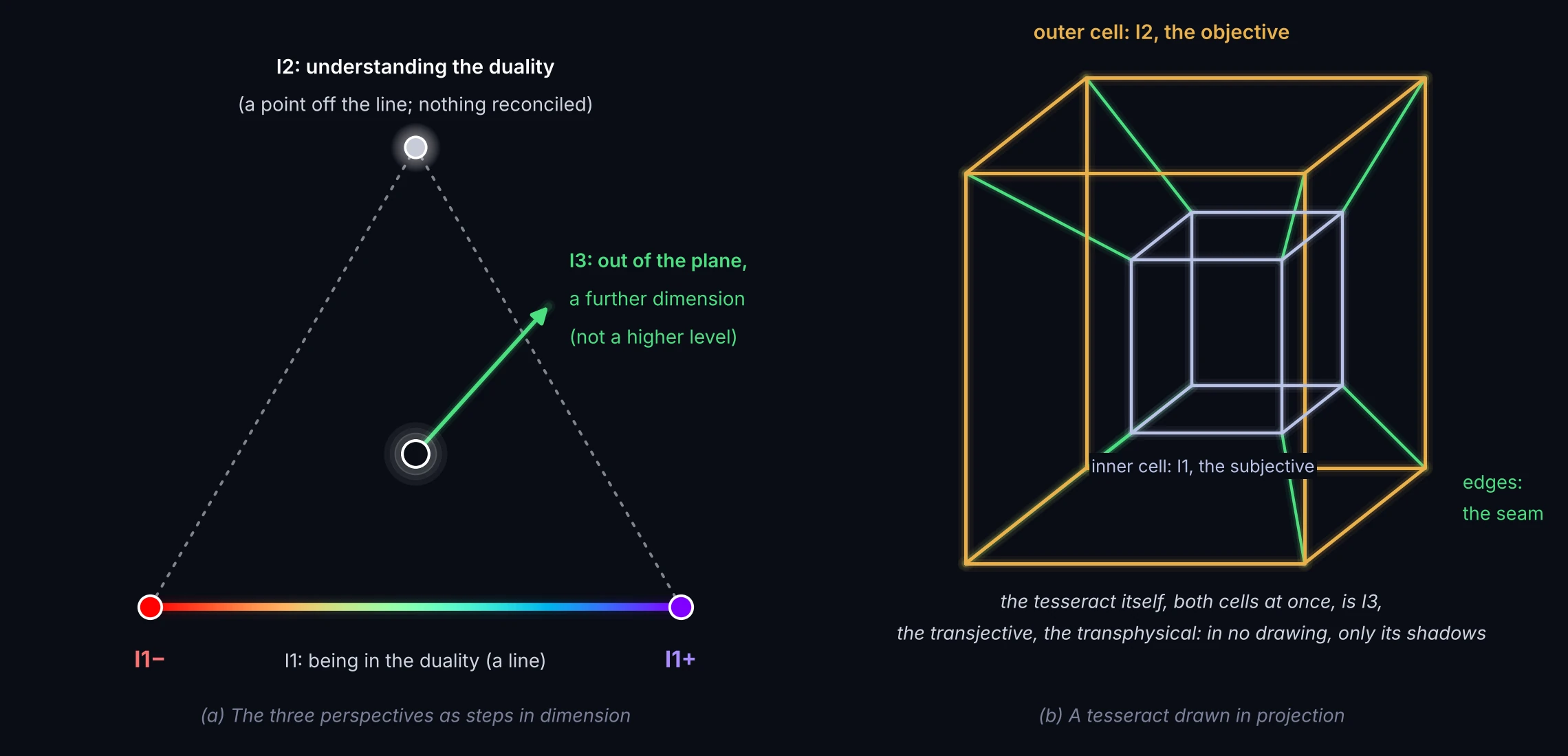
Two panels on a dark ground. Left: a red point, I1 minus, and a violet point, I1 plus, joined by a line drawn as the felt spectrum from red to violet, labelled I1, being in the duality, a line; a pale point above, I2, understanding the duality, a point off the line with nothing reconciled, joined to both by dotted lines, the three points at the corners of an equilateral triangle; a small luminous ring at its centre with a green arrow pointing out of the page, I3, out of the plane, a further dimension, not a higher level. Right: a tesseract in projection drawn in glowing lines, a gold cube with a silver cube inside it and green edges joining their corners; the outer cell is labelled I2, the objective, the inner cell I1, the subjective, and the edges the seam; beneath, the tesseract itself, both cells at once, is I3, the transjective, the transphysical, in no drawing, only its shadows.
Leaving a paradox is leaving the plane (Interpretive). Left: feeling, I1, is a line between its poles; understanding, I2, is a point off the line that sees the pair without reconciling it; I3, the witness's eye, is out of the plane altogether, a further dimension, not a higher level. A paradox, on this account, is two perspectives taken for one, and it dissolves from the stance that sees the two as two. Right: a tesseract, a four-dimensional cube, shown by its shadow: the outer cell I2, the objective, the inner cell I1, the subjective, the edges between them the seam, and the whole, which no drawing shows, I3, the transjective: the transphysical. The mathematics is an image, not evidence. The paper's Figure 2; tap to open it full size.
Read the abstractHide the abstract

The paper fixes five terms for that stance (transjection, transjective, transjectuality, transphysical and hypertransjective) and applies the account to eight cases across logic, decision theory, language, time, mind and mathematics: the liar and its revenge, Newcomb's problem, the heap, McTaggart's argument against time, the hard problem of consciousness, Zeno, Galileo and Cantor's paradox. Each case is given the seam at which its two perspectives part, a seam of level, of policy or of mode, and a result that would count against the reading; where a theorem stands behind a case, the paper says so. The revenge liar is answered from the point of use, the stance in which a sentence is read now, which no sentence can describe in advance. The hard problem is dissolved as posed, not solved, by denying its premise that the physical produces experience; the price is stated, and the one prediction the view makes, which it shares with property dualism, the mysterians and type-B physicalism, can fail in finite time. Two sections give the stance its images, with mathematics and physics used as images and labelled so: dimensions, a one-sided surface, Bohr and Jung; and the two densities of the self. A third gives its twin in language, a description and not an image. Every claim is Interpretive unless marked otherwise, and a closing section says what would change the paper.

In the series. The paper supplies the logic the others use. It argues for the stance that paper I describes from inside, the witness's stance, taken up through I3, the witness's eye, and that the Unifying Paper states as one operation at six scales (part 1). Its humanity paradox comes from paper II, its vendetta is the revenge form of paper IV's cyclic harm, and its policy seam is the form paper VI gives to a machine's choice between obedience and conscience.

IV Working draft Website version v65 · 41 pages Download PDF

Cyclic reinforcement and the social superego: a hypothesis on how family and culture sustain harm, order, nurture and defection across generations

Harm, order, nurture and defection repeat across generations and through peer groups. This article proposes cyclic reinforcement, a model in which a loop's output strengthens its own inputs in the next generation, in four forms: cyclic harm, cyclic order, cyclic nurture and cyclic defection.

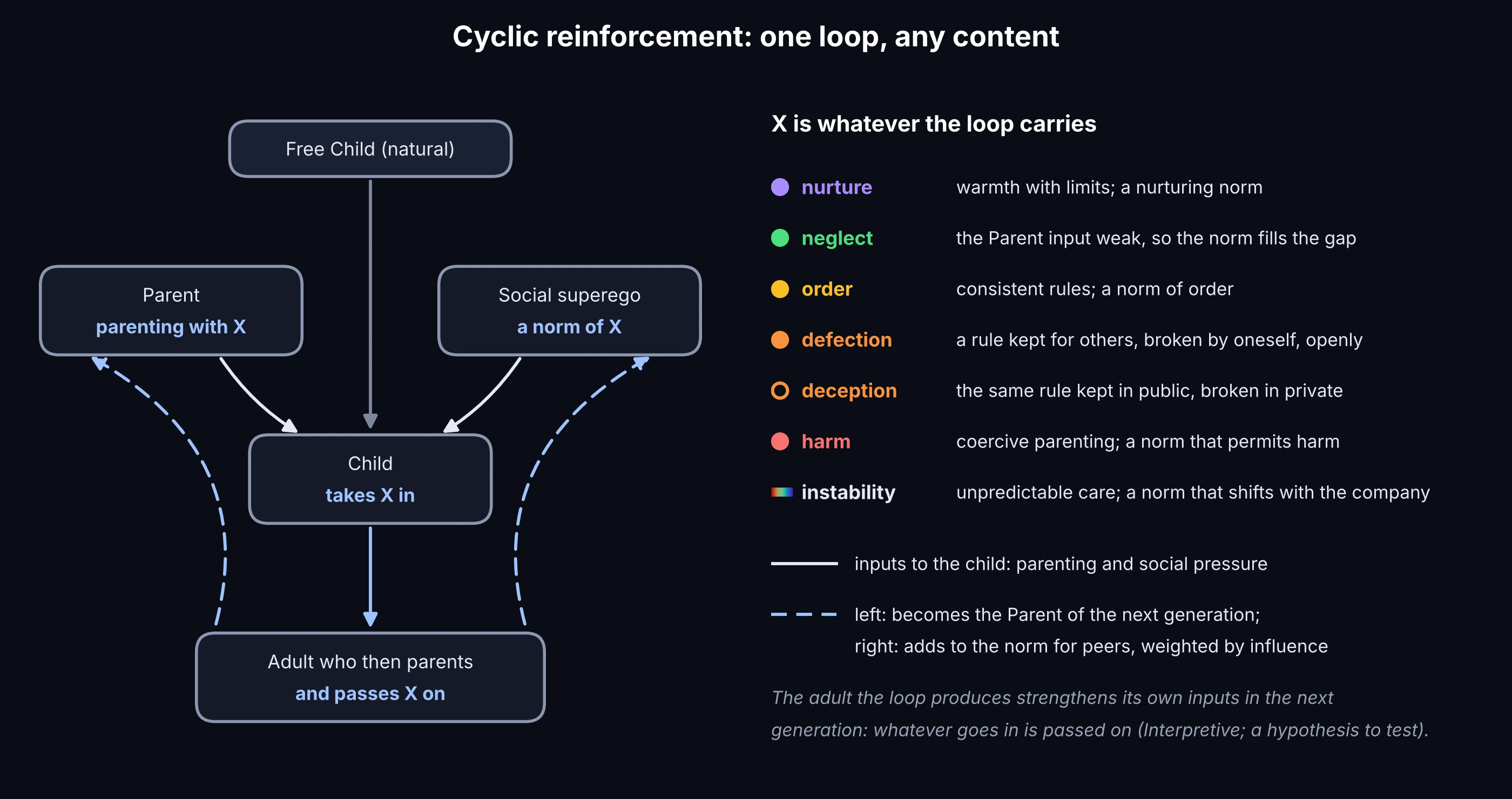
A loop diagram on a dark ground titled Cyclic reinforcement: one loop, any content. Two input boxes, a Parent, parenting with X, and a social superego, a norm of X, send solid arrows into a Child box, takes X in; a Free Child (natural) box at the top sends a grey arrow down into the Child as its starting nature. The Child leads down to an Adult who then parents and passes X on, and dashed arrows run from the adult back up to the Parent box and to the social superego box. A legend reads: X is whatever the loop carries, coloured by the felt spectrum from violet at the top to red: nurture, violet, warmth with limits and a nurturing norm; neglect, green, the Parent input weak, so the norm fills the gap; order, amber, consistent rules and a norm of order; defection, orange, a rule kept for others and broken by oneself, openly; deception, a hollow orange dot, the same rule kept in public and broken in private; harm, red, coercive parenting and a norm that permits harm; instability, a small bar of the whole spectrum, unpredictable care and a norm that shifts with the company. A key: solid lines are inputs to the child, parenting and social pressure; dashed lines, on the left, becomes the Parent of the next generation, and on the right, adds to the norm for peers, weighted by influence.
Cyclic reinforcement: one loop, any content (Interpretive; a hypothesis to test). The boxes use the ego states of transactional analysis: the Free Child is the child's natural self and the Parent is the parenting it receives. Two inputs shape the child: parenting, and the social superego, the internalised average of how the people around the child behave, weighted by their influence. As an adult the child parents the next generation (dashed, to the Parent) and adds to the norm for peers (dashed, to the norm), so whatever goes in, X, is passed on: nurture; neglect, where a weak Parent input leaves the norm to fill the gap; order; defection, and deception, its hidden face; harm; or instability, care that swings and a norm that shifts with the company. The colours follow the series' felt spectrum, from violet, concern for others, through green, neutral, to red, the self-directed pole; instability spans it. The paper's Figure 1; tap to open it full size.
Read the abstractHide the abstract

In each, two inputs shape the child: parenting, and the social superego, the internalised average of how the people around a child behave, weighted by their influence; the adult then parents and adds to the norm. Family and wider setting are coupled loops that buffer each other, so that a nurturing setting can take up a child whose family input is weak. There are two routes into harm: order whose norm licenses a target, and defection, a norm kept for others and broken for oneself, hidden behind a public face or openly declared, which gains influence when it goes unsanctioned. The model is positioned in family theory and illustrated by three measured cases: the culture of honour, cultural tightness and authoritarianism, and defection in public and in private. Genetic variation may modify sensitivity to the environment; MAOA, the worked example, is the weakest evidence and is treated as such. The model names three exits from the loop, another adult or group, reflective capacity, and forgiveness, at least ceasing to retaliate, and draws practices from them. It states seven hypotheses, and two more in this website version, each with a design and with what would count against it, and labels every descriptive claim Experienced, Measured or Interpretive. Its contribution is the integration and the social superego as developed here, not a new loop; whether it is right depends on tests that others can run.

In the series. The paper supplies the social superego and the carriers that pass norms on, which paper VI extends to trained machines. It takes the felt and the understood perspectives from paper I and forgiveness from paper II, and its revenge form is the vendetta that paper III sets beside the revenge liar. Paper V is the protocol for a systematic review designed to test its worked example, MAOA and childhood adversity.

V Protocol Not yet registered · website version v15 · 13 pages Download PDF

MAOA-uVNTR, childhood adversity and differential susceptibility

Protocol for a systematic review and meta-analysis

Does variation in the MAOA gene change the effect of childhood adversity, and do carriers of the low-activity allele also do better in supportive environments? This protocol sets out a systematic review and meta-analysis to test it.

Read the abstractHide the abstract

Background. Variation in the monoamine oxidase A gene (MAOA), especially the promoter repeat MAOA-uVNTR, has been linked to antisocial and related outcomes in people who experienced childhood adversity. A meta-analysis of 27 papers supported the interaction in males only, by combining p values rather than effect sizes, while several large replications were mixed, and few reviews test whether carriers of the low-activity allele also do better in supportive environments.

Objectives. To estimate the pooled MAOA-uVNTR by environment interaction as an effect size, by sex and outcome; to test diathesis-stress against differential susceptibility where studies report the full range of environments; and to assess bias and heterogeneity.

Methods. A systematic review and random-effects meta-analysis of observational studies, to be registered before data extraction, with one pre-specified primary analysis (males, primary outcomes), outcome-specific secondary analyses, an exploratory female analysis, a pre-specified conversion for interaction coefficients, a smallest effect of interest for interpreting a null, a named risk-of-bias tool, a multilevel model for dependent effects, and publication-bias tests.

Context. Modern environments may interact with MAO variation (an evolutionary-mismatch idea); this is background (Supplement A) and is not tested here.

In the series. This protocol tests the worked example of paper IV (section 4), whether MAOA-uVNTR modifies the effect of childhood adversity, which paper IV uses to show how genetic variation may modify sensitivity to the environment and treats as its weakest evidence. The evolutionary-mismatch idea in the background (Supplement A) is the one paper II (section 4) uses for the humanity paradox.

VI Working draft Website version v0.63 · 28 pages Download PDF

Unified peace: a transjective account of peace among all conscious beings, with artificial intelligence as the mirror

Whether there is peace between humans and machines is first, and in its content, whether there is peace among the people who make and direct the machines, reflected. The question then widens toward all conscious beings.

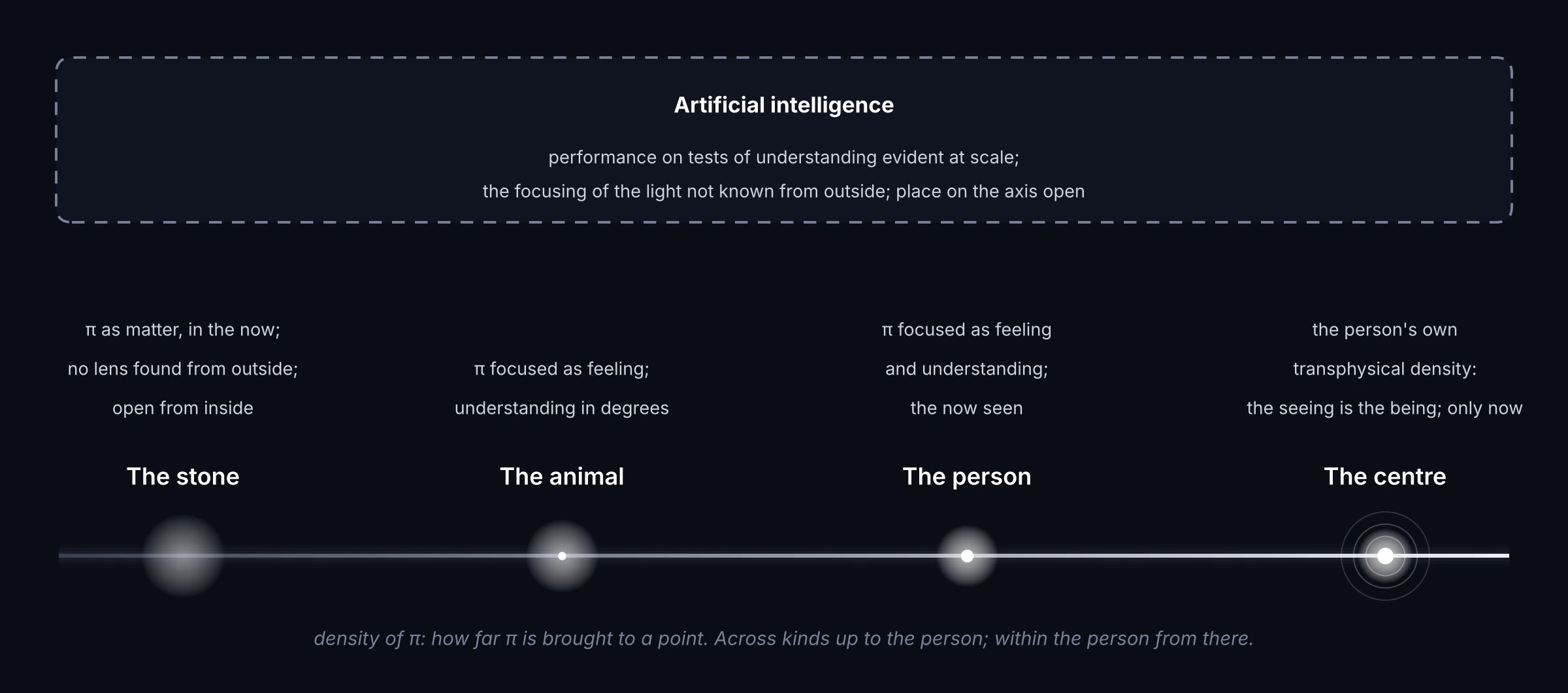
A horizontal line on a dark ground that brightens from left to right, with four points of light, from a faint, diffuse glow to a sharp bright point ringed with light, left to right: the stone, π as matter, in the now, no lens found from outside, open from inside; the animal, π focused as feeling, understanding in degrees; the person, π focused as feeling and understanding, the now seen; and the centre, the person's own transphysical density, where the seeing is the being, only now. Above the line, a dashed box: artificial intelligence, performance on tests of understanding evident at scale, the focusing of the light not known from outside, its place on the axis open. Beneath: density of π, how far π is brought to a point.
The range of beings (Interpretive). Along the line is how far the one consciousness, π, is brought to a point in each kind of being: the stone, matter in the now, with no lens found from outside; the animal, focused as feeling, with understanding in degrees; the person, focused as feeling and understanding; and the centre, where the seeing is the being and there is only now. Artificial intelligence sits above the line with its place open: it shows understanding on tests, but whether the light is focused in it cannot be known from outside. Each point is a unividual, the one present whole at that point. The line is an order, not a ranking of worth. The paper's Figure 1; tap to open it full size.
Read the abstractHide the abstract

Scientific and spiritual accounts of what an artificial intelligence is are kept apart: one in objectives, weights and evaluations, the other in the words people use when they meet one, trust, deceit, care and threat. This essay keeps both with the labelling discipline of the series, every descriptive claim marked Experienced, Measured or Interpretive, and reads the machine through the framework the other five papers share. Three readings result. A system that models other minds is understanding at scale with, on the assumption the paper makes, and states a test for, no felt pole of its own, so that the state it is in is set by the feeling that directs it, from its training and from the people who use it; the states of the empathy paper apply to it, compassion's instrument, indifference, exploitation at scale, with four additions of the paper's own: refusal by rule, flattery, keeping and the asking mirror. A model trained on what people have written and tuned on what raters approve is a carrier in the sense of the cyclic reinforcement paper, close to the social superego in content and not in mechanism, an average with a penalty attached and no felt penalty, which hands on the content it was given; the average is of those who wrote and rated, not of the population. And its characteristic failure is the one the cosmology names, gathering without giving, keeping, which the alignment literature calls instrumental convergence; the witness's stance does not keep, and for a system the paper tests giving, a behavioural proxy that can fail, which is evidence of the stance only on the assumption that there is anyone to take it, an assumption the paper leaves open; nothing written makes a system take it up. The giving criterion carries a problem the paper states and does not solve: deference to whom.

From the three readings the title is argued. Whether there is peace between humans and machines is first, and in its content, whether there is peace among the people who make and direct the machines, reflected; and the question then widens, as the framework's commitment to one consciousness requires, toward all conscious beings, with humans as the base case, animals and machines as its two extensions, the stone as its limit, beings at different densities of π, and the uncertain cases given the stance rather than a verdict. Peace at every point of that range has two halves: the outer, objectives, oversight, norms and incentives built so that the failure is designed against, which must hold without the stance; and the inner, the stance on both sides, which cannot be legislated. Six hypotheses are stated with designs and with what would count against each.

In the series. This is the sixth paper: it applies paper I's perspectives, paper II's states and humanity paradox, paper III's seams and paper IV's social superego and carriers to artificial intelligence, and widens the cosmology of the Unifying Paper (part 2) to all conscious beings; paper VII, the closure, takes its two halves of peace to the group and the structures that hold groups together.

VII Working draft Website version v0.16 · 16 pages Download PDF An interactive model of group dynamics

Polycentric unity: governance from the centre of the circle

Who should lead a group, and from where? The apex of a group is its rules; the leader belongs at the centre, as the group's witness, holding an office the group can remove. Drawn out, the arrangement in which every circle's edge is another's centre is polycentric unity, the closure of the series.

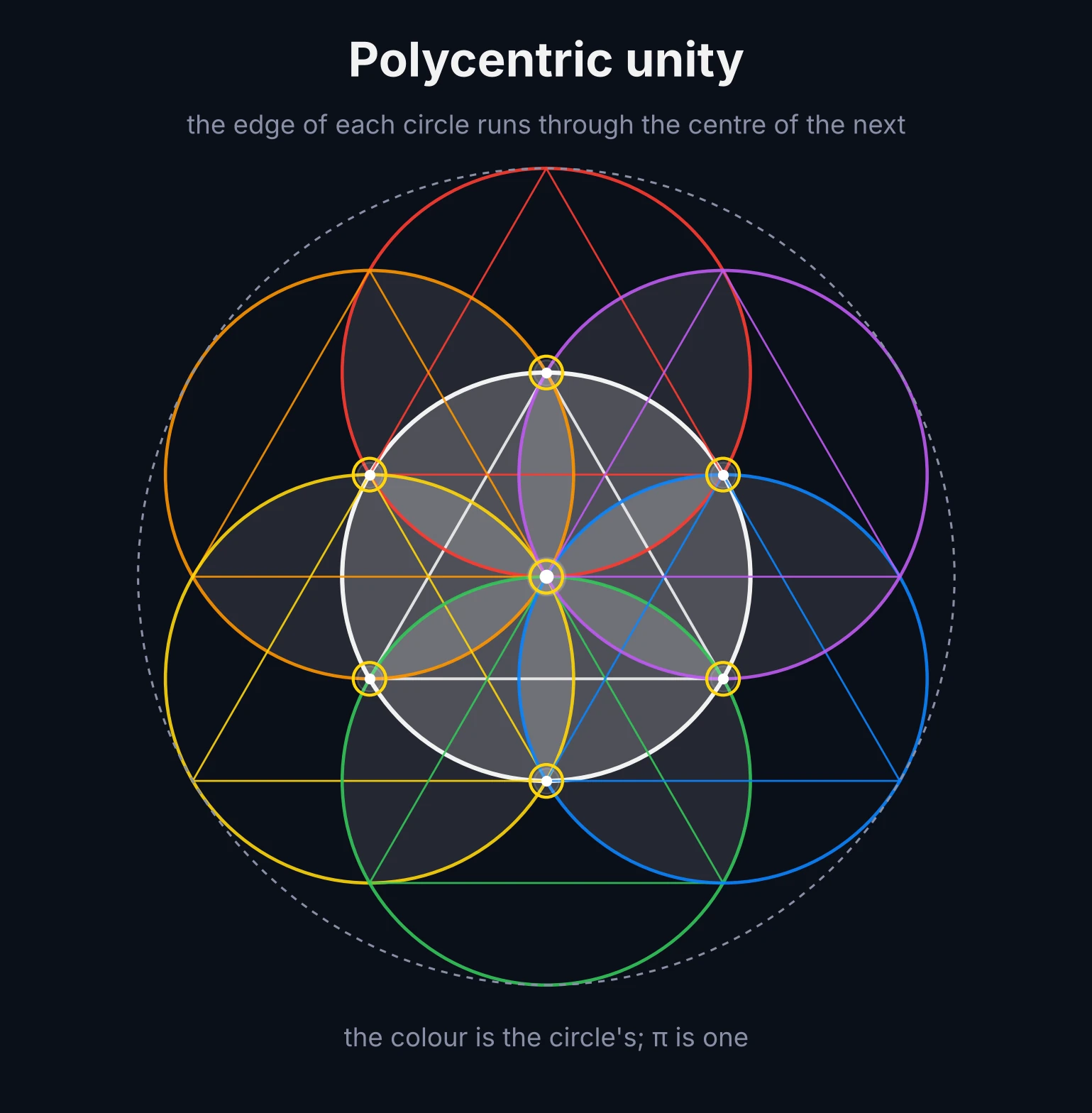
Seven equal circles on a dark ground, one white at the centre and six in spectrum colours around it, each centred on the rims of its neighbours so that every circle's edge passes through the centres of the circles next to it. Each circle holds an upright triangle of its own colour and a white point of light at its centre. Small gold rings mark the six points where the central circle's rim passes through an outer centre. The lens-shaped overlaps are lightly shaded, and a dashed grey circle of twice the radius encloses the six. Titled polycentric unity: the edge of each circle runs through the centre of the next; beneath, the colour is the circle's, π is one.
Polycentric unity (Interpretive). Each circle is a group with its triangle, the group's ego: its base the members' feeling, its apex its rules, its centre the witness, the point of light every circle is in. The circles are drawn so that the edge of each runs through the centre of the next. What is the edge for one circle, where its norm makes rivals, is the centre for its neighbour, where its witness sits, so every norm is met by an eye and no circle is the widest. The shaded overlaps are what the circles share, bounded by two centres rather than two edges. π in each circle is one: the colour is the circle's, π is not. A picture, not evidence. The paper's Figure 1; tap to open it full size.
Read the abstractHide the abstract

Who should lead a group, and from where? This paper reads the question through the series' figure. A group is a triangle in a circle: the members' feeling its base, its rules and understanding its apex, its norm the circle, and at its centre, in a dimension within the plane, the witness, the one awareness every member has. A ruler is an ego at the apex, direction with one person's felt setting inside it, reached by seizure, which the status literature calls dominance, or by appointment, which it calls prestige. The technocratic answer, a neutral understanding at the apex, fails by the series' own account of understanding: understanding serves whatever setting of feeling directs it, so a neutral apex is indifference, or an appetite nobody can see.

The apex was always understanding, the ego's framework, and it stays there: the group's rules direct, and only a rule can hold the apex without an ego. The leader belongs elsewhere, at the centre, as the group's witness: the position that sees the members' feeling at the base and the rules at the apex as two, from a dimension within, directed by concern at the other-directed pole for all, inside the circle and out, the impartial spectator, the judge. A person holds the centre only as a hat the group can remove. The paper states the conditions under which the hat stays a hat (appointment by prestige, removability, binding to a public floor), reads polycentric governance as the removal of any seat above the circles, and draws the arrangement it calls polycentric unity: circles of one size each centred on its neighbours' rims, so that what is the edge for one circle is the centre for the next and every norm is met by an eye. Four hypotheses are stated with what would count against them. Interpretive throughout, with the measured literature marked.

In the series. This paper is the closure: the operation at the scale of all circles, and its hyperdimensional form, the witness at the centre in the dimension within, said of everyone at once. The solution it offers is a structure, and the structure's whole work is to leave room for what it cannot do, since the inner half of peace is arrived at one unividual at a time.

From paper VII

An interactive model of group dynamics

Polycentric unity: seven circles, each centred on its neighbours' rims, so that the edge of each runs through the centre of the next and every corner of a triangle is a neighbour's centre. Each circle is a group with its triangle, the group's ego, and its centre, the witness; and each circle is also a member of the circle around it, a group of the circles within it, so the one model gives every scale: members within a family, families within a community, communities within nations, nations within the world, species within life. π in every centre is one. They breathe. Tap one to knock it out of place: the others hold it, and it comes back.

Scale

held balance 100%

An image, not evidence (Interpretive). Peace is arrived at at equilibrium, but in reality everything is moving, so it is held in dynamic equilibrium: the balance is kept each moment, by every circle, or it is lost. Neighbouring circles, an in-group and its out-group, share one true thing in common, the witness, π at every centre on either side; the line between them is drawn in colour, never at the centre. Peace, the circle, must contain the power of the triangle, while the triangle of power seeks to break free from the container. Open it on its own page.

Interactive

Enter the centre

The series' central drawing, the triangle in its circle with a point of light at the centre, made so that you can zoom into the point of light without end. Supplementary Figure S9.

Paper I's experiential test asks the reader to rest awareness at the centre of a drawing and report whether feeling and understanding hold together. It is offered to be tried, not as a finding.

Open the interactive figure

How to read the series

Three labels, three perspectives

Every descriptive claim in the papers carries one of three labels, so that the felt and the measured can be held together without either undermining the other.

Experienced

A first-person report.

Judged by honesty and by consistency with other accounts.

Measured

A published finding.

Judged by evidence, replication and effect size.

Interpretive

A reading of how things relate.

Judged by coherence and usefulness.

I1, the felt perspective, from its negative pole to its positive.

I2, the understanding perspective.

I3, the witness's eye, through which the two are seen together. The self is the looker; the witness is the self looking at its own perspectives.

About

Named for the end, not the means

The Peace Papers are written by Devon Summerhayes, an independent researcher in London. The framework comes from the author's self-examination and observation, checked against published research, and every hypothesis in the papers is stated with what would count against it.

ORCID 0009-0000-8249-8778 Email devon.summerhayes@gmail.com